Liquid / Metal – The Abyss & T2
James Cameron has always been comfortable on the bleeding edge of technological developments, whether 3D and performance capture for Avatar, the genuinely colossal moving platforms employed in Titanic, epic green screens for True Lies or his pioneering CGI work on The Abyss and Terminator 2.
Shortly after T2, we soon received a steady stream of films employing its now seemingly trite “morphing” shots (Star Trek employed it in both Star Trek VI and Deep Space 9), but nothing from that era has come close to maintaining the impact of its effect shots, so rapid and impressive has the progress been since then.
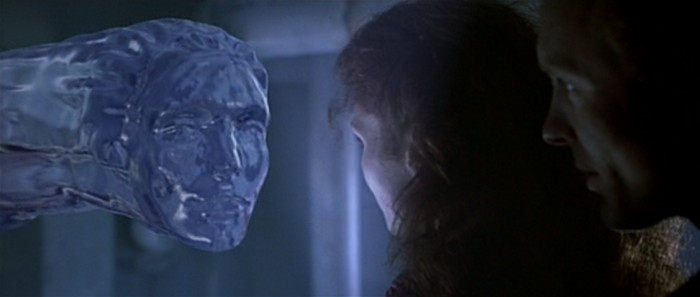
One need only look at the sequence from the previous page to realise what a step up it was to move from the angular, two-dimensional polygons of a stained-glass window to a fluid, reflective, interactive substance like a tentacle of water or a liquid-metal killing machine. The amount of effort, care and computing power alone is amply demonstrated by the fact that The Abyss made do with a couple of brief sequences, while T2 was able to deliver set piece after set piece. As with every other development celebrated on these pages, progress is made by technicians at an always-impressive rate.
What is arguably just as impressive about both the alien tentacle and the T1000 is how well suited they were to the story being told. Sorry to keep picking on the same two hapless victims, but both Twister and Hollow Man delivered special effects on a “because we can” basis, rather than looking for the right story to tell – a worthwhile story. With The Abyss they are at the bottom of the ocean, so of course the aliens are going to be liquid-ish.
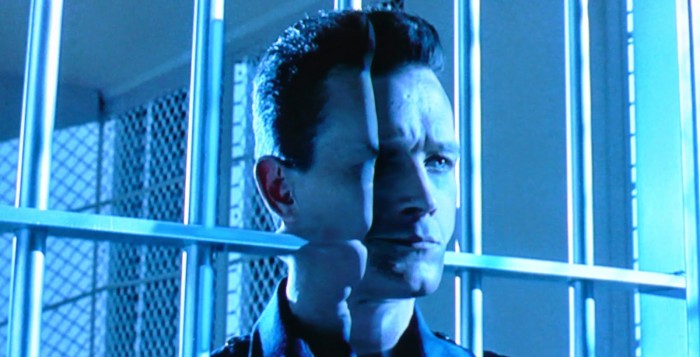
It wasn’t simply a case of showing off what they could do, the film-makers were using ground-breaking special effects in service of the story. The same argument can be made for the T1000 – an upgrade to the T800 was needed – a more technologically advanced robot, an “edge” to compensate for not being a physical match for the Austrian Oak. It was absolutely perfect.
The actual work involved in creating these effects is worth an article all on its own, indeed Rickitt’s hefty tome* devotes 20+ pages to 3-D computer animation, including digital face replacement, skeletons, animating digital characters, performance capture, textured surfaces, virtual cameras, rendering and motion blur.
One incredibly important element in “selling” the liquid metal T1000 shots was making the Terminator reflective. This required complex ray-tracing so that, for example, when the T1000 gloops into the helicopter outside Dyson’s building, the shocked face of the pilot is reflected in the Terminator as it takes human form. As with all of these disciplines, there are technicians out there with patience and focus that you and I cannot imagine.
*Richard Rickitt’s Special Effects: The History & Technique