Aaron Sorkin’s The Social Reckoning is a riveting investigative drama with a voice all of its own, one that never leans on the shadow of David Fincher’s The Social Network. Serving as writer, co-producer, and director, Sorkin puts a distinct stamp on the film. While comparisons to Fincher’s work are unavoidable, his new film feels no need to copy its predecessor’s style, standing best as a spiritual companion piece to the 2010 classic, rather than a direct sequel.
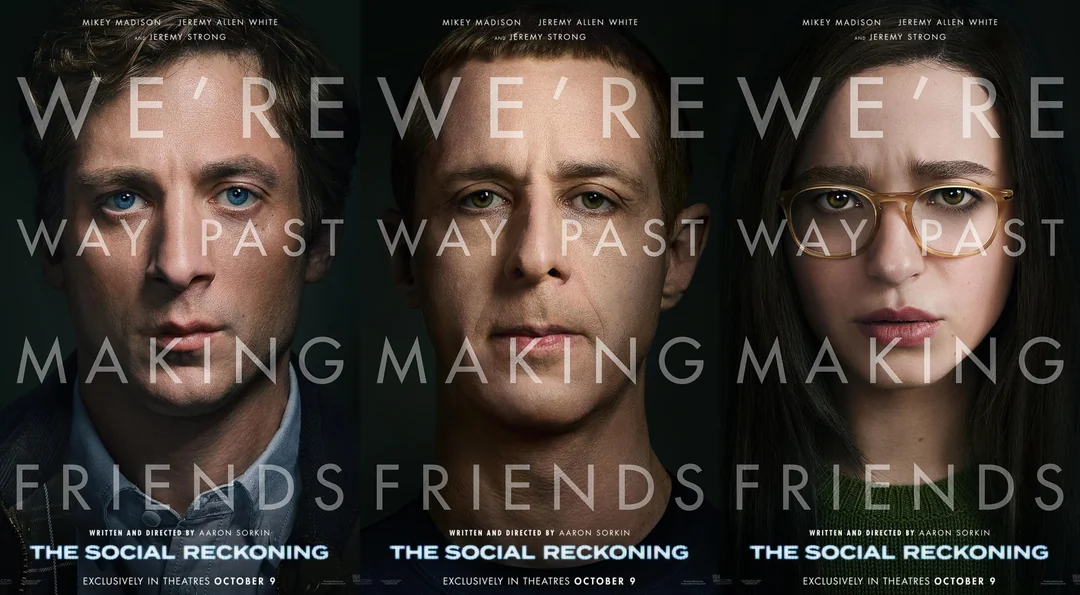
Anora alum Mikey Madison stars as Frances Haugen, a Facebook product manager who becomes convinced the platform is hiding what it knows about the harm its algorithm is causing. Faced with the reality of what she has learned, Frances agrees to come forward as a whistleblower and secretly shares internal documents with Jeff Horwitz (Jeremy Allen White, excellent), a Wall Street Journal reporter, who is preparing a tell all on Meta and and its owner.
Meanwhile, Jeremy Strong steps into the role of Facebook founder, Mark Zuckerberg. The billionaire was famously played by Jesse Eisenberg in the Social Network, a role he refused to reprise, citing the need to distance himself from the man. The ensemble cast also features Bill Burr and Wunmi Mosaku as Charlie and Raya, members of Zuckerberg’s legal team who are prepping him for an imminent senate inquiry. Elsewhere, Billy Magnussen plays Teddy, another Facebook executive played with the actor’s signature slick villainy.
What really stands out here is how The Social Reckoning refrains from making Zuckerberg the main attraction. Though Strong delivers a great performance, his screen time is limited. Instead, the movie zooms out to examine the broader picture: the systemic fallout that occurs when profit consistently takes priority over public well-being and truth.
The narrative gains added weight when it tackles the aftermath of the January 6 Capitol riots, the spreading of the election fraud lie, grounding the story in real-world political urgency. It serves as a stark warning about social media’s ability to manipulate discourse. Sorkin handles this heavy thematic territory through his trademark rapid-fire, dialogue-driven conversations, a style fans will instantly recognise.
Madison and White bring incredible emotion and dramatic weight to their roles. Their dynamic gives the film a human core that makes you root for their partnership. While the script occasionally dips into sappy territory, the strong performances make even the melodrama feel believable and genuinely impactful.
Visually and rhythmically, the movie carries the feel of a 1990s political drama. But rather than feeling dated, this traditional approach works to its advantage, placing the focus squarely on Sorkin’s sharp writing and the cast’s acting. Burr is a standout as a key adviser to Zuckerberg. His delivery is note perfect, proving that the comedian’s famously caustic timing translates well to Sorkin’s rapid-fire dialogue. l
Ultimately, The Social Reckoning deserves to be judged on its own merits rather than constantly weighed against The Social Network. Even if it doesn’t fully reach the absolute heights of its predecessor, Sorkin guides the story with confidence, delivering a smart, engaging, and thought-provoking political thriller that is both informative and urgent.