


Have you ever sat back and wondered why certain spaces feel instantly familiar, even if you have never set foot in them? For many of us, the answer lies in the power of the silver screen. Over the decades, cinema has built a highly specific visual language around the world of gaming. We have been conditioned to associate these environments with low, atmospheric lighting, the soft clink of glasses, and a palpable sense of anticipation.
Today, this cinematic influence has travelled far beyond the cinema screen. It has actively shaped how modern interactive entertainment is designed and presented. From the way cameras pan across a table to the specific warm tones of the lighting, the line between movie sets and live gaming has beautifully blurred.
The Cinematic Language of the Casino: Analysing Iconic Film Scenes
To understand how we arrived at this highly polished aesthetic, we have to look back at the films that defined the genre. Directors have long used the casino floor as a canvas to explore human character, tension, and style.

Take Martin Scorsese’s 1995 epic, Casino. Scorsese, working alongside the brilliant cinematographer Robert Richardson, treated the setting as a character in its own right. The film is a sensory overload of bright neon, intense primary colours, and brilliant flashes of light. Richardson used high-angle crane shots that swept across the vast, bustling floors, making the environment feel immense, alive, and slightly overwhelming. The camera was always in motion, mirroring the constant energy of the room. This visual scale created a backdrop where every interaction felt significant, framed by the endless glow of the slot machines.

In stark contrast, Martin Campbell’s Casino Royale in 2006 took a much more intimate, focused approach. The high-stakes Texas Hold’em tournament in Montenegro is a masterclass in psychological tension. Instead of wide, sweeping shots, Campbell relied heavily on tight, claustrophobic close-ups. The camera lingers on the twitch of an eye, a bead of sweat, or the quiet slide of chips across the green baize. The lighting here is moody and low-key, casting deep shadows that isolate the players from the rest of the world. It is an aesthetic that prioritises quiet drama and intense focus, proving that you do not need bright lights to create a powerful atmosphere.
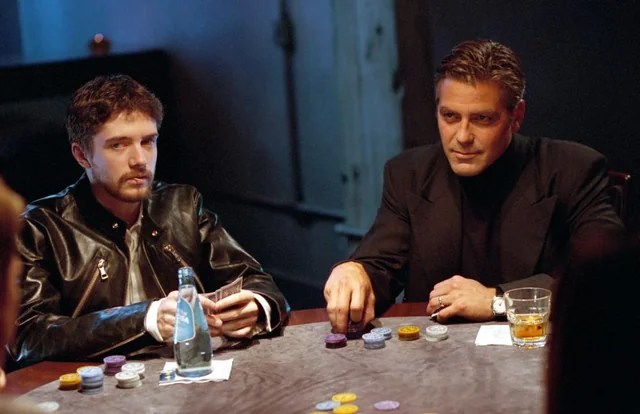
Then we have Steven Soderbergh’s Ocean’s Eleven from 2001, which presented a different flavour altogether. Soderbergh bathed his scenes in warm, golden tones and soft, flattering light, giving the entire film an effortless, cool sophistication. The camera work is smooth and gliding, tracking the characters as they move with absolute confidence through the opulent surroundings of the Bellagio. There is no frantic movement here; everything is stylish, relaxed, and incredibly inviting.
These three distinct visual styles have deeply entered our collective cultural consciousness. Whether it is the grand scale of Scorsese, the intense focus of Campbell, or the cool luxury of Soderbergh, these films established a set of visual expectations that we still carry with us today.
The Art of the Frame: Replicating the Silver Screen
When live interactive entertainment first started appearing on our screens years ago, the visual quality was rather basic. It often involved a single, static camera pointed at a table in a brightly lit, sterile room. It felt more like watching a security feed than participating in something special.
Thankfully, production teams quickly realised that if they wanted to truly capture the imagination of players, they needed to borrow directly from Hollywood’s playbook. Today, the design of modern live broadcast studios is a highly sophisticated discipline, employing professional directors, lighting experts, and camera operators.

One of the most significant changes has been the adoption of multi-camera setups. Instead of a single fixed angle, modern live games use several high-definition cameras positioned around the studio. A typical game might begin with a wide, establishing shot of the room to set the scene, reminiscent of Soderbergh’s smooth introductions. As the action begins, the view seamlessly cuts to a medium shot of the presenter, and eventually to an extreme close-up of the cards being dealt or the roulette wheel spinning. These cuts are not random; they are carefully timed to build natural anticipation, drawing your eye exactly where it needs to be at that precise moment.
Lighting has also undergone a massive transformation. Designers now avoid the flat, harsh fluorescent lighting of the past, opting instead for professional three-point lighting setups. By using a key light, a fill light, and a backlight, they can create depth and dimension. This ensures the presenters are flatteringly lit whilst the physical table retains a rich, textured look. Warm golds, deep velvets, and soft blues are often used in the background to create a sense of depth, mimicking the classic colour palettes we see in high-budget films.
Even the set design itself is heavily influenced by cinema. You will often see rich mahogany wood, polished brass, and plush carpets that look as though they have been lifted straight from a Bond set. It is all about creating a believable, immersive space that feels premium and exclusive.
Bridging Film and Play: The Tech Behind the Scene
Of course, looking like a movie is only half the battle. To make the experience truly engaging, the technology running behind the scenes has to be completely seamless. Traditional tabletop games rely on physical touch and immediate feedback, things that can easily get lost in translation when moving to a screen.
To bridge this gap, developers have turned to cutting-edge streaming and software technology. The real unsung hero here is Optical Character Recognition (OCR). This clever technology uses specialised cameras to read the physical cards, dice, or roulette numbers the moment they are revealed. It then instantly translates that physical information into digital data, displaying it on the player’s screen in real time.
This means there is no lag or delay in the action. When a card is dealt, you see the result instantly, maintaining the natural rhythm of the game. This instant feedback is crucial for keeping the narrative flow of the game alive, mirroring the snappy, well-edited pace of a movie scene.
Furthermore, high-definition, low-latency streaming networks ensure that the video feed remains crisp and clear, even on mobile devices. There is nothing quite like a stuttering video feed to ruin the illusion of luxury, so ensuring a smooth, uninterrupted stream is paramount. The user interfaces are also designed to be as unobtrusive as possible, blending into the background so they do not distract from the physical action taking place on the screen.
The Modern Red Carpet Experience

This evolution in technology and design has culminated in a highly sophisticated form of entertainment. You no longer need to travel to London’s West End or fly to Las Vegas to experience the atmosphere of a premium gaming room. Instead, that same level of care, attention to detail, and cinematic quality is now available from the comfort of our own homes.
Modern platforms have done a marvellous job of curating this high-end experience. A wonderful example of this can be found at the Virgin Games online casino, where the live dealer suites are designed to feel like an extension of a luxury film set. When you join a game, you are greeted by highly professional, charming croupiers who are trained to interact with the camera just like television presenters.
The studios themselves are styled with the same attention to detail you would expect from a top-tier production designer. With beautiful, warm lighting, elegant backdrops, and multiple camera angles that capture every movement in crystal-clear definition, it is an incredibly polished experience. It successfully recreates that feeling of stepping past the velvet rope and onto the red carpet, showing just how far the industry has come.
Of course, whilst we all enjoy the drama and style of these cinematic experiences, it is always worth remembering that real life does not come with a Hollywood script. It is important to keep things fun and balanced, always playing responsibly and setting sensible limits before you start.
Ultimately, the influence of cinema on interactive gaming has been a massive win for players. By embracing the lighting, framing, and pacing of the silver screen, modern platforms have managed to elevate simple tabletop games into rich, visual spectacles. It is a testament to the enduring power of film, proving that a touch of Hollywood magic can make almost any experience feel a little more extraordinary.


